Why Your Kid's School Just Got a Lot Better at Getting Through to You
Why Your Kid's School Just Got a Lot Better at Getting Through to You
That 6 PM robocall about tomorrow's snow day? There's serious science behind why it actually works.
If you've noticed your phone buzzing more often with updates from school—field trip reminders, attendance alerts, event invitations—you're not imagining things. Schools across the country are investing in automated parent communication systems, and the research shows these tools are genuinely transforming how families stay connected to what's happening in their children's education.
But not all school communication is created equal. Here's what the latest findings reveal about what makes these systems work—and what you should expect from your school.
5 Insider Secrets About School Communication That Actually Reaches You
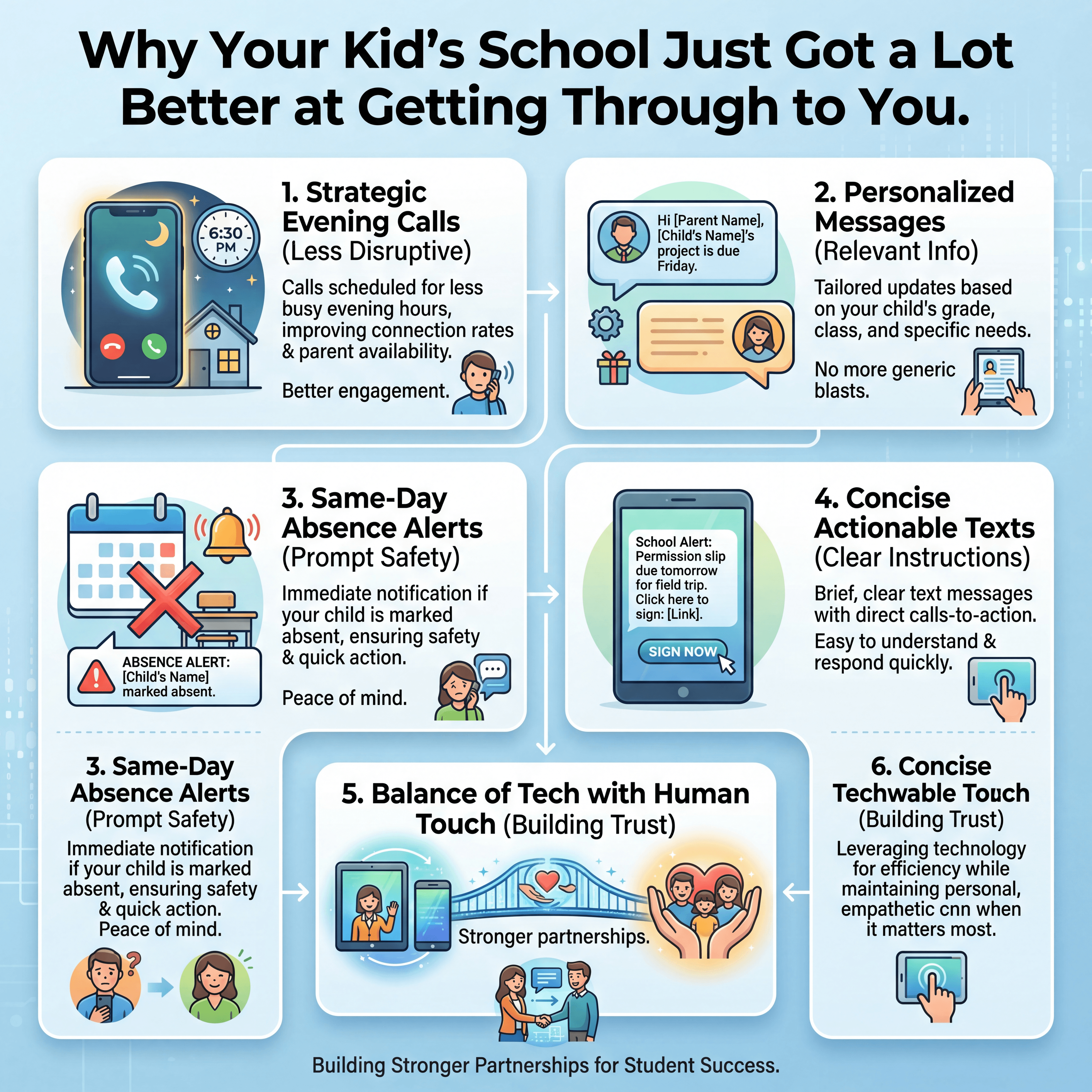
1. The evening call isn't an accident—it's strategy.
Research shows that messages sent between 6 PM and 10 PM on weeknights achieve significantly higher engagement rates than anything sent during school hours. Schools using data-driven timing aren't bothering you randomly; they're reaching you when you're most likely to actually hear the message and act on it.
2. Personalization dramatically increases your attention.
Generic "all parents" broadcasts get ignored. But when a message includes your child's name, their specific teacher, and a date that matters to your family? That's intentional design. Studies confirm parents are far more likely to engage with communications directly relevant to their specific child's situation.
3. Same-day absence notifications genuinely improve attendance.
When schools send an automated alert the moment your child is marked absent, something powerful happens. A rigorous randomized trial found these instant notifications produced measurable reductions in chronic absenteeism—especially for students with attendance challenges. You knowing immediately gives you power to respond immediately.
4. One-sentence actionable messages outperform lengthy updates.
Research on teacher-parent communication found that brief, specific messages about what students need to improve resulted in a 41% reduction in course failures compared to vague positive feedback. The best school communications tell you exactly what to do—"Read together 20 minutes tonight"—not just that everything's fine.
5. Technology works best when it doesn't replace the human touch.
Here's the counterintuitive finding: "Showing up to school is a human decision driven by authentic relationships—not AI". The schools getting this right use automation for logistics and reminders, while preserving genuine human connection for conversations that matter.
The Numbers Don't Lie
- 90%+ open rates achievable with well-designed automated phone systems
- 50% reduction in administrative workload reported by schools with integrated systems
- 41% fewer course failures when parents received weekly one-sentence progress texts
- 42% higher homework completion rates when teachers maintained frequent phone contact with families
- 26% of messages fail to deliver on any given day due to outdated contact information
What This Means for You
The best schools are investing in communication systems that respect your time and actually help your family. But technology only works when the data behind it is accurate.
Here's your action step: Update your contact information with your child's school today—including your preferred communication method. Ask if they offer customization options so you receive what matters most (attendance alerts, event reminders, emergency notifications) without the noise.
And when that 6 PM call comes through about tomorrow's schedule change? Now you know there's real research ensuring it reaches you exactly when it should.
Found this helpful? Forward to another parent who's drowning in school apps and wondering what actually works.
Related Articles
Why Your Kid's School Just Got a Lot Better at Getting Through to You
Discover how automated communication systems are transforming parent-school connections.
Read more →The 3-Minute Call That Can Transform Your Child's School Year
Research shows how positive teacher-parent communication drives academic success.
Read more →