The 3-Minute Call That Can Transform Your Child's School Year
The 3-Minute Call That Can Transform Your Child's School Year
Why the most powerful tool in education costs nothing—and most parents never experience it.
Here's a number that should stop every parent in their tracks: only four out of ten families have ever received a phone call from a teacher or administrator specifically about their child. And when schools do call? It's almost always bad news.
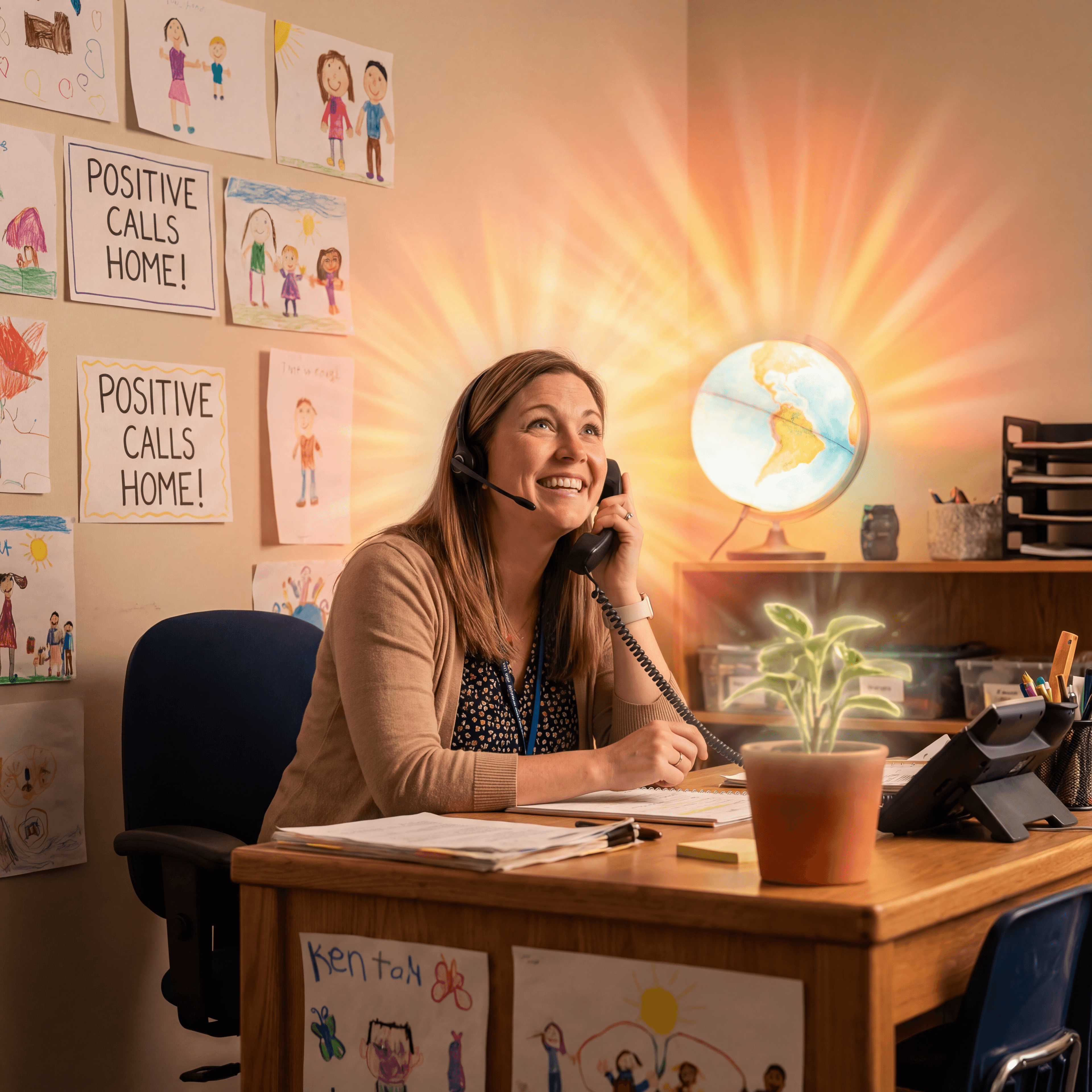
But buried in Harvard research is a stunning finding: when teachers flip the script and make quick, positive calls home, student outcomes explode. We're talking 40% more homework completed, 41% fewer course failures, and classrooms that actually work.
This isn't feel-good theory. It's one of the most cost-effective interventions in education—and it's dramatically underused. Here's what every parent and educator needs to know.
5 Insider Secrets About Positive Phone Calls Home
1. One Sentence Can Cut Failures by 41%
Researchers tested something almost laughably simple: teachers sent parents one personalized sentence per week about their struggling student's progress. The result? Course failures dropped from 15.8% to 9.3%—and the cost per additional credit earned was less than one-tenth of traditional remediation programs.
2. Generic Praise Doesn't Work—Specificity Does
"Your daughter did great today" lands flat. But "I noticed Maya stayed after class to help a classmate understand fractions—that kind of generosity really stood out" changes everything. Behavior-specific praise gives parents real insight and gives students a roadmap for what to keep doing.
3. The First Call Rewires the Entire Relationship
When teachers lead with good news early in the school year, it fundamentally shifts how parents perceive them—from potential adversary to trusted ally. That trust becomes invaluable when real concerns arise later. Parents who've heard positives first are far more receptive to problem-solving together.
4. Middle Schoolers Need This Most (Even If They Act Like They Don't)
Early adolescence is a paradox: students are pulling away from parents while desperately needing adult guidance. Teachers who maintain positive family contact become crucial bridges—trusted adults who can reach students in ways parents sometimes can't during this tricky developmental window.
5. It Actually Saves Time Long-Term
Teachers who make regular positive calls report fewer behavioral problems requiring intervention later. The relationship investment on the front end prevents the crisis management on the back end.
The Numbers Don't Lie
| Outcome | Improvement |
|---|---|
| Homework completion | +40% |
| Behavioral redirects needed | -25% |
| Class participation | +15% |
| Course failures | -41% |
| Class attendance (with text alerts) | +12% |
What You Can Do Right Now
If you're a parent: Don't wait for the school to reach out. Email or text your child's teacher with a simple question: "What's one thing my child is doing well?" You'll be amazed how that opens the door.
If you're an educator: Try the "5x5 approach"—five students, five minutes each, one day a week. Track it. Start in the first weeks of school. The compound effect is real.
If you're an administrator: Protect time for this practice. Model it yourself. What gets celebrated gets replicated.
The research is unambiguous: positive communication isn't a nice-to-have. It's foundational. And in a world of expensive interventions and complicated programs, sometimes the most powerful tool is simply a phone call that starts with good news.
Share this with a teacher or parent who needs to hear it.
Related Articles
Why Your Kid's School Just Got a Lot Better at Getting Through to You
Discover how automated communication systems are transforming parent-school connections.
Read more →The 3-Minute Call That Can Transform Your Child's School Year
Research shows how positive teacher-parent communication drives academic success.
Read more →