The way High School teachers are reaching out to parents in 2026
The way High School teachers are reaching out to parents in 2026
If you're the parent of a high school student, here's a question worth asking: When was the last time a teacher called you with good news?
For most families, school contact means something's wrong—a missed assignment, a behavioral issue, an attendance flag. But research tells a dramatically different story about what happens when teachers flip the script and reach out with praise instead of problems.
The findings are striking enough that schools across the country are rethinking how—and how often—teachers connect with families. Here's what the evidence reveals, and why it matters for your student.
5 Research-Backed Truths About Positive Teacher Communication
1. It supercharges homework completion.
Harvard researchers found that frequent positive teacher-family communication improved the odds students would complete their homework by 40 percent. That's not a marginal gain—that's the difference between a student who struggles with accountability and one who shows up prepared.
2. It predicts college enrollment better than you'd expect.
Students whose parents were highly involved during high school were far more likely to pursue higher education—80 percent compared to just 56 percent of their peers with less-involved parents. Positive communication is one of the most effective ways to maintain that involvement as teens naturally pull away.
3. It changes classroom behavior—fast.
The same research showed a 25 percent reduction in teachers needing to redirect student attention and a 15 percent jump in class participation when families and teachers communicated regularly. Positive calls home create accountability loops that students actually respond to.
4. High schoolers secretly want it.
Despite the eye rolls, students consistently rank positive calls home as their preferred reward for good behavior. Teens care deeply about how they're perceived by their parents—they just won't admit it at the dinner table.
5. Teachers want to do it—but can't.
Here's the hard truth: 85 percent of teachers report moderate to high burnout, and nearly half cite parent communication demands as a contributing factor. Teachers know these calls work. They simply don't have the bandwidth to make them consistently.
The Numbers That Should Get Every Parent's Attention
- 16 percentage points: How much less chronic absenteeism grew in schools with strong family engagement versus those without
- 69%: Spanish-speaking parents who report language barriers made school participation difficult
- 5.9 hours/week: Time saved by teachers using AI-powered tools—equivalent to six full weeks per school year
What This Means for You
The gap between what research proves works and what schools can realistically implement has historically been wide. But that's changing.
Tools like Classvox.com are helping teachers scale positive outreach by allowing them to compose personalized messages that get delivered automatically—in the parent's preferred language, at optimal times, without requiring teachers to navigate scheduling nightmares or emotionally draining conversations.
The teacher still writes the message. The AI handles the logistics. Parents hear good news about their kids. Everyone wins.
Your Move
Ask your school whether they have systems in place for positive parent outreach—not just problem alerts. Advocate for communication tools that support teachers in reaching all families, not just the ones who are easiest to contact.
And if you receive one of those rare positive calls? Let your teen know it happened. Research says they're listening more than they let on.
Found this helpful? Forward it to another parent who could use some good news about good news.
Related Articles
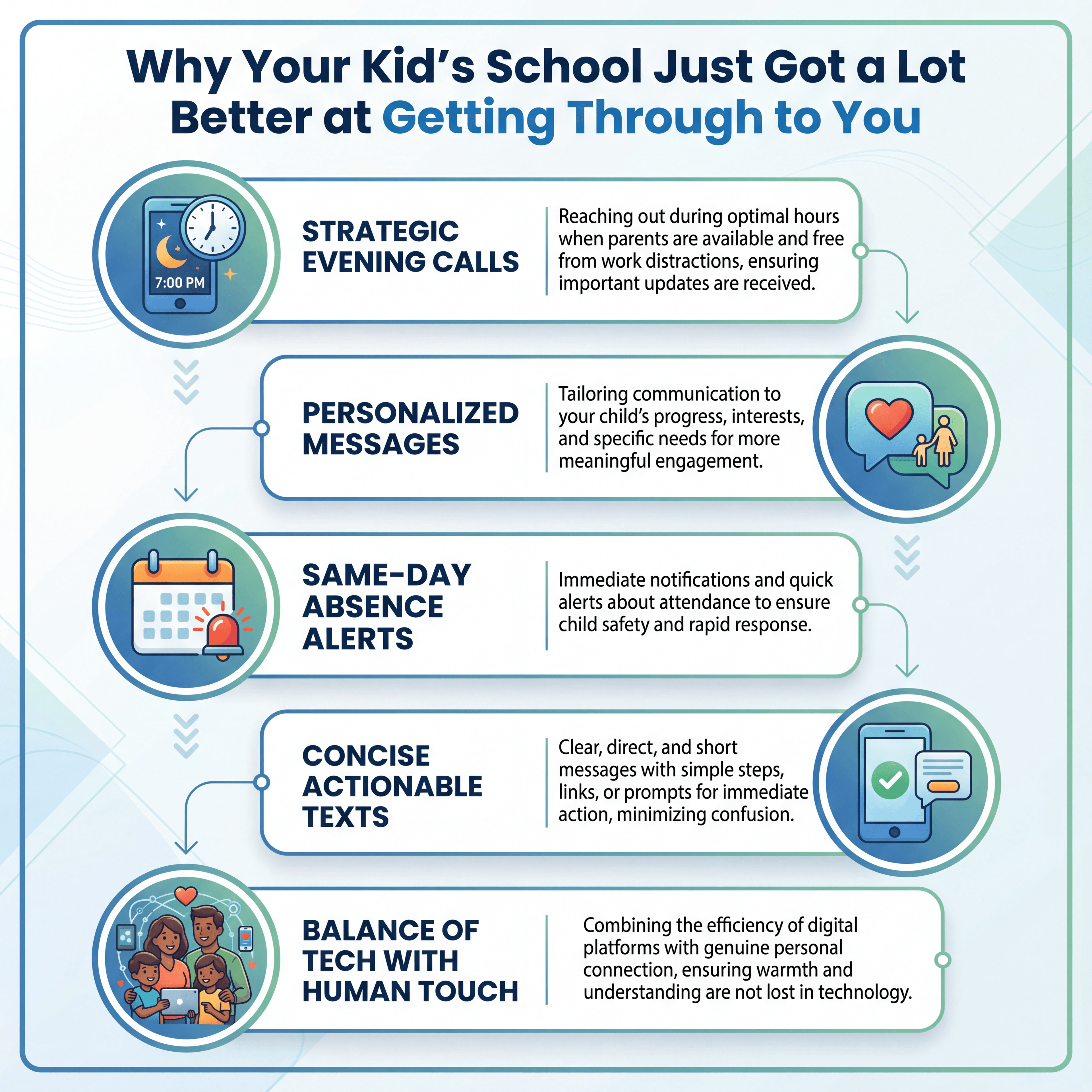
Why Your Kid's School Just Got a Lot Better at Getting Through to You
Discover how automated communication systems are transforming parent-school connections.
Read more →The 3-Minute Call That Can Transform Your Child's School Year
Research shows how positive teacher-parent communication drives academic success.
Read more →